How the Laser Fork Solution Could Improve Warehouse Safety and Efficiency
Inventor Donald M. Ortiz turned a real-world warehouse problem into a patent-pending concept designed to help forklift operators position loads more accurately.
Every day in warehouses across the country, forklift operators face a common challenge: determining how far the forks should enter a pallet. Judging the correct fork depth can be difficult, particularly in fast-paced warehouse environments. Inserting forks too far can contribute to product damage, broken pallets, contact with nearby loads, and other safety concerns. That's the problem Donald M. Ortiz of Mason, Ohio, set out to address.
While working at a third-party logistics company, Donald witnessed firsthand the costs associated with damaged and overturned pallets. He recognized that operators often had limited guidance for determining proper fork positioning and believed there could be a better way to provide real-time feedback. While using a laser to measure distances in a warehouse, Donald began considering how similar technology might be applied to forklift operation. That idea led to the development of the Laser Fork Solution, a patent-pending system designed to assist operators in determining proper fork depth when engaging a pallet.
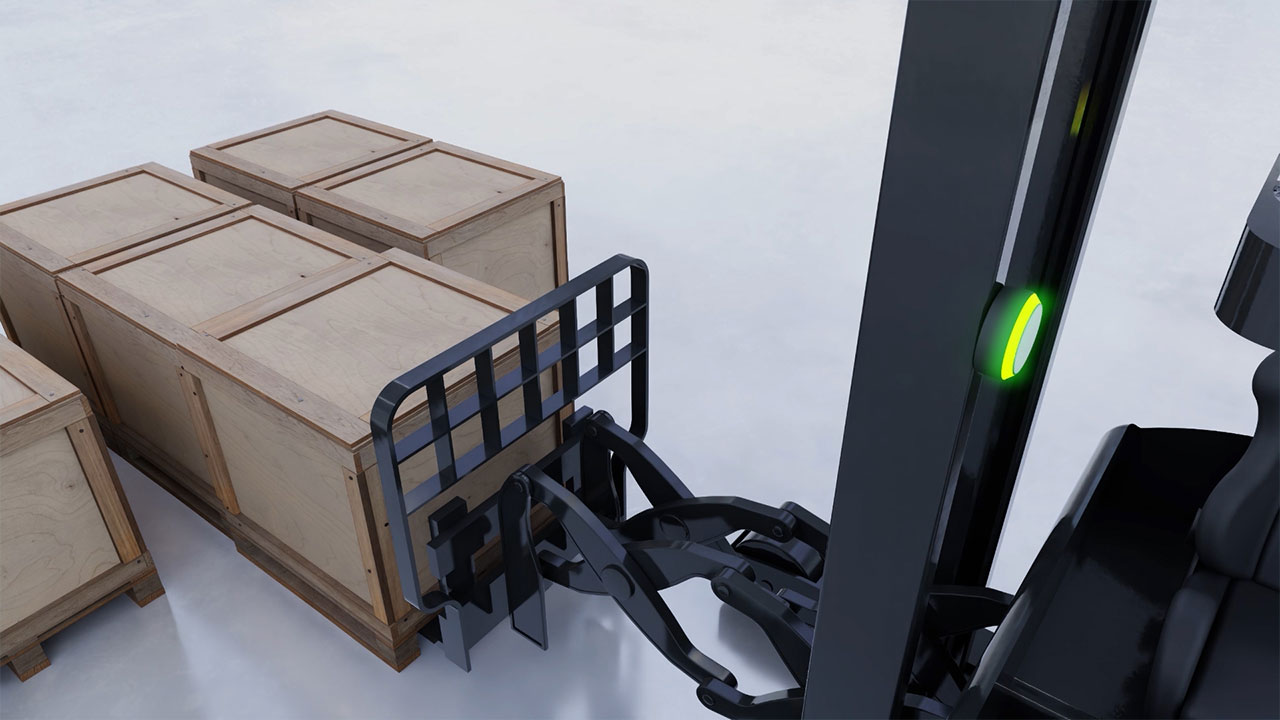
So how does it work? The Laser Fork Solution incorporates laser-based proximity detection to provide information about fork positioning as the operator approaches and engages a pallet.
- Laser-Based Precision: The system uses laser-based sensing to help determine fork position and provide the operator with guidance during pallet engagement.
- Customizable Depth Targets: A keypad interface allows operators to set or adjust a desired depth based on the particular pallet or load configuration.
- Visual and Audio Alerts: When the predetermined fork position is reached, the system can provide visual and audible notifications to the operator.
- Broad Forklift Compatibility: The concept is designed for use with a variety of forklift and pallet configurations without requiring complex camera-based vision systems.
- Real-Time Adjustability: Depth settings can be changed to accommodate different loads, pallets, operating conditions, and operator requirements.
The concept is intended to help reduce excessive fork penetration, which may lower the risk of damaged products, pallets, and neighboring inventory. Providing operators with consistent positioning feedback may also help improve loading efficiency and reduce reliance on visual estimation alone.
The Laser Fork Solution is patent pending and is being presented as a potential licensing or commercialization opportunity for manufacturers, distributors, logistics companies, and other businesses serving the warehouse and material-handling industries. Companies interested in learning more about the invention or exploring potential licensing opportunities can visit laserforksolution.com.


